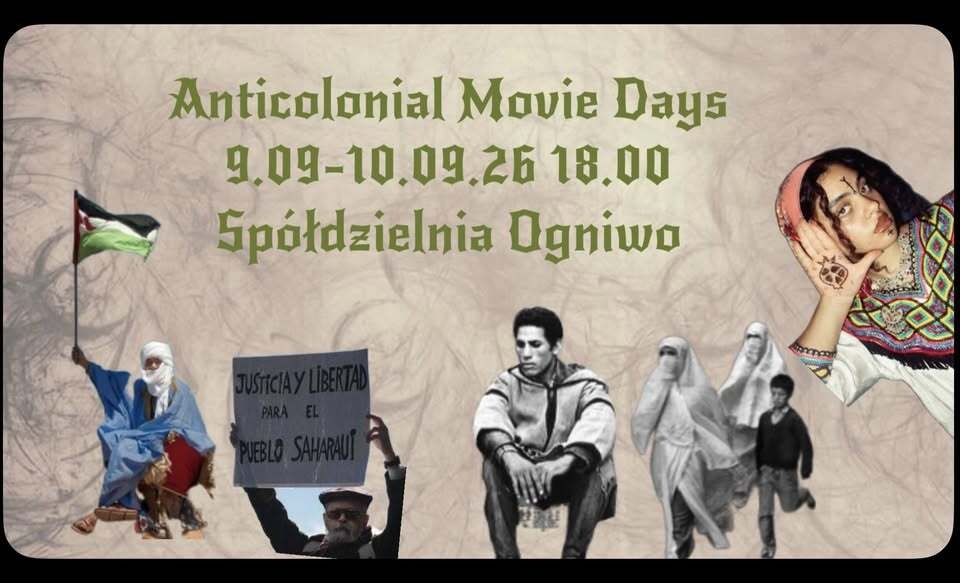
Anticolonial Movie Days: 𝟡.𝟘𝟡-𝟙𝟘.𝟘𝟡.𝟚𝟘𝟚𝟞 | 𝕆𝕘𝕟𝕚𝕨𝕠
Anticolonial Movie Days 9.09-10.09 [ENGLISH DESCRIPTION BELOW]
Spółdzielnia Ogniwo, Cafe Bund i Za’atar Project zapraszają na projekcje filmów z dyskusją Anticolonial Movie Days.
Masz dosyć oglądania Odysei i utrwalania kolonialnych standardów w przemyśle filmowym? Zamiast hollywoodzkich filmów realizowanych za wielką kasę na terytoriach okupowanych, możesz obejrzeć razem z nami nasze propozycje, które opowiadają o kolonializmie.
✊Poznanie historii jest jedną formą solidarności. Oprócz tego chcemy wesprzeć osoby, w które wymierzone są faszystowskie polityki naszego kraju. Dlatego w trakcie tych dwóch dni będziemy zbierać odzież męską dla uchodźców zamkniętych w polskich ośrodkach detencyjnych. Prosimy o przynoszenie ubrań nowych lub w dobrym stanie wg poniższej listy:
t-shirty, bluzy, longsleeve męskie, w neutralnych kolorach, rozmiary od M w górę
spodnie męskie długie i krótkie spodenki męskie
buty męskie wsuwane lub na rzepy / bez sznurówek
skarpety męskie
bielizna męska (tylko NOWA)
żele pod prysznic 2 w 1
dezodoranty męskie
proszek do prania
artykuły higieniczne dla niemowląt
artykuły higieniczne dla kobiet
Zachęcamy do podarowania chociaż jednej rzeczy, którą będziemy mogły umieścić w paczkach!
👉9.09 19.00
„Desert PHOSfate” (2023) reż. Mohamed Sleiman Labat
Napisy w języku angielskim
z prelekcją Magdaleny Link-Lenczowskiej
👉10.09 18.00
„Bitwa o Algier” (1966) reż. Gillo Pontecorvo
Napisy w języku polskim (język oryginalny arabski i francuski)
z wprowadzeniem Laurie Debeni
📍Miejsce: Spółdzielnia Ogniwo, Smolki 11a
💸Wstęp wolny
🎬🎬🎬🎬🎬🎬🎬🎬🎬🎬🎬🎬🎬
O filmach:
Desert PHOSfate
„Desert PHOSfate” (2023) to film eksperymentalny pochodzącego z Sahary Zachodniej artytsty Mohameda Sleimana Labata. Środowy pokaz będzie jego premierą w Polsce. Opowiada o społeczności Sahrawi, kiedyś nomadycznej, obecnie żyjącej marokańską okupacją lub w algierskich obozach dla uchodźców. Bada wpływy ekstrakcji fosforanów na środowisko, najbliższe otoczenie ludności. Historię Sahrawi przekazują sami członkowie społeczności. To od nich dowiadujemy się o przeszłości, odebranym im sposobie życia, ich wytrwałości. Powstaje narracja, której nie znamy z zachodnich produkcji.
Mohamed Sleiman Labat, żyjący w obozie dla uchodżców Sahrawi, na łamach Guardiana napisał: „Reżyserzy i dzienikarze Sahrawi, próbujący udokumentować codzienne życie pod marokańską okupacją, mogą skończyć w więzieniu. Dla marokańskiego reżimu, kamera w rękach Sahrawi zagraża oficjalnemu przekazowi, w którym Sahara Zachodnia jest częścią Maroka.” Christopher Nolan na niektóre lokacje dla „Odysei” wybrał właśnie ziemie Sahary Zachodniej. Fikcyjne tragedie w obiektywie sławnego reżysera zyskują rozgłos, a militarne działania Maroka wobec cywili pozostają w cieniu. „Desert PHOSfate” przybliża kulturę okupowanej społeczności, ale też dyskutuje z zachodnimi, kapitalistycznymi sposobami tworzenia sztuki.
Mohamed Sleiman Labat - filmowiec, artysta wizualny, tłumacz. Założyciel centrum kultury Motif Art Studio w obozie dla uchodźców Saharawi w Algierii.
Magdalena Link-Lenczowska - redaktorka, kuratorka, krytyczka filmowa. Działa w La Central, kantabrskim barze-centrum kultury, gdzie współorganizowała m. in. „Dni Sahrawi”.
Bitwa o Algier
„Bitwa o Algier" w reżyserii Gillo Pontecorvo (1966) to film, który był wykorzystywany do szkoleń ruchów rewolucyjnych takich jak IRA, Tamilskie Tygrysy, Weathermen czy Czarne Pantery.
Jego tematyka uaktualnia się w każdym dziesięcioleciu, nie tylko dzięki prawdziwie ponadczasowemu stylowi dokumentalnemu operatora Marcello Gatti, ale także dlatego, że jest to jeden z najlepszych i najbardziej obiektywnych filmów o ruchu oporu jaki kiedykolwiek został nakręcony i jeden z najlepszych filmów w historii kina w ogóle. W 1966 roku otrzymał nominację do Oscara dla najlepszego filmu zagranicznego. Film zdobył Złotego Lwa na festiwalu w Wenecji w 1969 roku, oraz nominację do Oscara za najlepszą reżyserię i scenariusz w tym samym roku. Gdy film wszedł na ekrany we Francji, właściciele kin, w których pokazywano "Bitwę o Algier" najpierw zaczęli dostawać pogróżki o podłożeniu bomby, później ekrany w salach kinowych niszczono za pomocą kwasu siarkowego, a w końcu wprowadzono zakaz jego wyświetlania. Film stanowił dla Francuzów, którzy właśnie wycofali swoje kolonialne wpływy z Algierii, oczywisty problem. Widzowie oglądający w roku 1969 "Bitwę o Algier" w kinach w Montrealu byli regularnie filmowani przez kanadyjską policję, a w krajach takich jak Republika Południowej Afryki film był zakazany. Wielu filmowców uznaje "Bitwę o Algier" za film, który miał istotny wpływ na ich twórczość - np. John Frankenheimer, Ken Loach, Paul Greengrass, Steven Soderbergh. Co więcej, film jest wymieniany jako ulubiony przez Andreasa Baadera, Carlosa Szakala.
Laurie Debeni - spółdzielczyni Ogniwa, antropolożka, aktywistka, organizatorka związków zawodowych, co-head of delegation polskiej delegacji Global Sumud Flotilla. Współzałożycielka projektów Cafe Bund i Za’atar Project.
ENG
Anticolonial Movie Days 9.09-10.09
Spółdzielnia Ogniwo, Cafe Bund and Za’atar Project invite you to film screenings and discussions as part of Anticolonial Movie Days.
Are you tired of watching The Odyssey and reinforcing colonial standards in the film industry? Instead of Hollywood films made with huge budgets on occupied territories, you can join us in watching our selections, which tell stories about colonialism.
✊ Learning about history is one form of solidarity. In addition, we want to support people targeted by the fascist policies of our country. That is why, during these two days, we will be collecting men’s clothing for refugees held in Polish detention centres. Please bring new or good-condition items according to the list below:
- men’s T-shirts, sweatshirts and long-sleeve shirts in neutral colours, sizes M and up
- men’s long trousers and men’s shorts
- men’s slip-on shoes or Velcro shoes / shoes without laces
- men’s socks
- men’s underwear (NEW only)
- 2-in-1 shower gels
- men’s deodorants
- washing powder
- hygiene products for babies
- women’s hygiene products
We encourage you to donate even just one item that we can include in the packages!
👉 9.09 19.00
“Desert PHOSfate” (2023), dir. Mohamed Sleiman Labat
English subtitles (original language Hassaniya, Arabic)
with a presentation by Magdalena Link-Lenczowska
👉 10.09 18.00
“The Battle of Algiers” (1966), dir. Gillo Pontecorvo
Polish subtitles (original languages: Arabic and French)
with an introduction by Laurie Debeni
📍 Venue: Spółdzielnia Ogniwo, Smolki 11a
💸 Free entry
🎬🎬🎬🎬🎬🎬🎬🎬🎬🎬🎬🎬🎬
About the films:
Desert PHOSfate
“Desert PHOSfate” (2023) is an experimental film by Western Sahara-born artist Mohamed Sleiman Labat. Wednesday’s screening will be its Polish premiere. It tells the story of the Sahrawi community, once nomadic and now living either under Moroccan occupation or in refugee camps in Algeria. It explores the impact of phosphate extraction on the environment and the immediate surroundings of the local population. The history of the Sahrawi is told by members of the community themselves. It is from them that we learn about their past, the way of life that was taken from them, and their resilience. A narrative emerges that we do not know from Western productions.
Mohamed Sleiman Labat, who lives in a Sahrawi refugee camp, wrote in The Guardian: “Sahrawi filmmakers and journalists attempting to document everyday life under Moroccan occupation can end up in prison. For the Moroccan regime, a camera in the hands of a Sahrawi threatens the official narrative in which Western Sahara is part of Morocco.” Christopher Nolan chose locations in Western Sahara for some scenes of The Odyssey. Fictional tragedies through the lens of a famous director gain publicity, while Morocco’s military actions against civilians remain in the shadows. Desert PHOSfate brings the culture of an occupied community closer to audiences, while also questioning Western, capitalist ways of creating art.
Mohamed Sleiman Labat - filmmaker, visual artist and translator. Founder of Motif Art Studio, a cultural centre in a Sahrawi refugee camp in Algeria.
Magdalena Link-Lenczowska - editor, curator and film critic. She works at La Central, a Cantabrian bar and cultural centre, where she has co-organised, among other events, “Sahrawi Days.”
The Battle of Algiers
“The Battle of Algiers” directed by Gillo Pontecorvo (1966) is a film that has been used for the training of revolutionary movements such as the IRA, the Tamil Tigers, the Weathermen and the Black Panthers.
Its subject matter remains relevant in every decade, not only because of cinematographer Marcello Gatti’s genuinely timeless documentary style, but also because it is one of the best and most objective films about a resistance movement ever made, and one of the greatest films in the history of cinema in general. In 1966, it received an Academy Award nomination for Best Foreign Language Film. The film won the Golden Lion at the Venice Film Festival in 1969, as well as Academy Award nominations for Best Director and Best Screenplay in the same year.
When the film was released in France, cinema owners showing The Battle of Algiers first began receiving bomb threats. Later, cinema screens were damaged with sulphuric acid, and eventually screenings of the film were banned. The film posed an obvious problem for the French, who had just withdrawn their colonial influence from Algeria.
Audiences watching The Battle of Algiers in cinemas in Montreal in 1969 were regularly filmed by the Canadian police, while in countries such as South Africa the film was banned. Many filmmakers consider The Battle of Algiers to have had a significant influence on their work, including John Frankenheimer, Ken Loach, Paul Greengrass and Steven Soderbergh. Moreover, the film is cited as a favourite by Andreas Baader and Carlos the Jackal.
Laurie Debeni - member of Spółdzielnia Ogniwo, anthropologist, activist and trade union organiser, co-head of delegation of the Polish delegation to the Global Sumud Flotilla. Co-founder of the Cafe Bund and Za’atar Project initiative
Spółdzielnia Ogniwo, Cafe Bund i Za’atar Project zapraszają na projekcje filmów z dyskusją Anticolonial Movie Days.
Masz dosyć oglądania Odysei i utrwalania kolonialnych standardów w przemyśle filmowym? Zamiast hollywoodzkich filmów realizowanych za wielką kasę na terytoriach okupowanych, możesz obejrzeć razem z nami nasze propozycje, które opowiadają o kolonializmie.
✊Poznanie historii jest jedną formą solidarności. Oprócz tego chcemy wesprzeć osoby, w które wymierzone są faszystowskie polityki naszego kraju. Dlatego w trakcie tych dwóch dni będziemy zbierać odzież męską dla uchodźców zamkniętych w polskich ośrodkach detencyjnych. Prosimy o przynoszenie ubrań nowych lub w dobrym stanie wg poniższej listy:
t-shirty, bluzy, longsleeve męskie, w neutralnych kolorach, rozmiary od M w górę
spodnie męskie długie i krótkie spodenki męskie
buty męskie wsuwane lub na rzepy / bez sznurówek
skarpety męskie
bielizna męska (tylko NOWA)
żele pod prysznic 2 w 1
dezodoranty męskie
proszek do prania
artykuły higieniczne dla niemowląt
artykuły higieniczne dla kobiet
Zachęcamy do podarowania chociaż jednej rzeczy, którą będziemy mogły umieścić w paczkach!
👉9.09 19.00
„Desert PHOSfate” (2023) reż. Mohamed Sleiman Labat
Napisy w języku angielskim
z prelekcją Magdaleny Link-Lenczowskiej
👉10.09 18.00
„Bitwa o Algier” (1966) reż. Gillo Pontecorvo
Napisy w języku polskim (język oryginalny arabski i francuski)
z wprowadzeniem Laurie Debeni
📍Miejsce: Spółdzielnia Ogniwo, Smolki 11a
💸Wstęp wolny
🎬🎬🎬🎬🎬🎬🎬🎬🎬🎬🎬🎬🎬
O filmach:
Desert PHOSfate
„Desert PHOSfate” (2023) to film eksperymentalny pochodzącego z Sahary Zachodniej artytsty Mohameda Sleimana Labata. Środowy pokaz będzie jego premierą w Polsce. Opowiada o społeczności Sahrawi, kiedyś nomadycznej, obecnie żyjącej marokańską okupacją lub w algierskich obozach dla uchodźców. Bada wpływy ekstrakcji fosforanów na środowisko, najbliższe otoczenie ludności. Historię Sahrawi przekazują sami członkowie społeczności. To od nich dowiadujemy się o przeszłości, odebranym im sposobie życia, ich wytrwałości. Powstaje narracja, której nie znamy z zachodnich produkcji.
Mohamed Sleiman Labat, żyjący w obozie dla uchodżców Sahrawi, na łamach Guardiana napisał: „Reżyserzy i dzienikarze Sahrawi, próbujący udokumentować codzienne życie pod marokańską okupacją, mogą skończyć w więzieniu. Dla marokańskiego reżimu, kamera w rękach Sahrawi zagraża oficjalnemu przekazowi, w którym Sahara Zachodnia jest częścią Maroka.” Christopher Nolan na niektóre lokacje dla „Odysei” wybrał właśnie ziemie Sahary Zachodniej. Fikcyjne tragedie w obiektywie sławnego reżysera zyskują rozgłos, a militarne działania Maroka wobec cywili pozostają w cieniu. „Desert PHOSfate” przybliża kulturę okupowanej społeczności, ale też dyskutuje z zachodnimi, kapitalistycznymi sposobami tworzenia sztuki.
Mohamed Sleiman Labat - filmowiec, artysta wizualny, tłumacz. Założyciel centrum kultury Motif Art Studio w obozie dla uchodźców Saharawi w Algierii.
Magdalena Link-Lenczowska - redaktorka, kuratorka, krytyczka filmowa. Działa w La Central, kantabrskim barze-centrum kultury, gdzie współorganizowała m. in. „Dni Sahrawi”.
Bitwa o Algier
„Bitwa o Algier" w reżyserii Gillo Pontecorvo (1966) to film, który był wykorzystywany do szkoleń ruchów rewolucyjnych takich jak IRA, Tamilskie Tygrysy, Weathermen czy Czarne Pantery.
Jego tematyka uaktualnia się w każdym dziesięcioleciu, nie tylko dzięki prawdziwie ponadczasowemu stylowi dokumentalnemu operatora Marcello Gatti, ale także dlatego, że jest to jeden z najlepszych i najbardziej obiektywnych filmów o ruchu oporu jaki kiedykolwiek został nakręcony i jeden z najlepszych filmów w historii kina w ogóle. W 1966 roku otrzymał nominację do Oscara dla najlepszego filmu zagranicznego. Film zdobył Złotego Lwa na festiwalu w Wenecji w 1969 roku, oraz nominację do Oscara za najlepszą reżyserię i scenariusz w tym samym roku. Gdy film wszedł na ekrany we Francji, właściciele kin, w których pokazywano "Bitwę o Algier" najpierw zaczęli dostawać pogróżki o podłożeniu bomby, później ekrany w salach kinowych niszczono za pomocą kwasu siarkowego, a w końcu wprowadzono zakaz jego wyświetlania. Film stanowił dla Francuzów, którzy właśnie wycofali swoje kolonialne wpływy z Algierii, oczywisty problem. Widzowie oglądający w roku 1969 "Bitwę o Algier" w kinach w Montrealu byli regularnie filmowani przez kanadyjską policję, a w krajach takich jak Republika Południowej Afryki film był zakazany. Wielu filmowców uznaje "Bitwę o Algier" za film, który miał istotny wpływ na ich twórczość - np. John Frankenheimer, Ken Loach, Paul Greengrass, Steven Soderbergh. Co więcej, film jest wymieniany jako ulubiony przez Andreasa Baadera, Carlosa Szakala.
Laurie Debeni - spółdzielczyni Ogniwa, antropolożka, aktywistka, organizatorka związków zawodowych, co-head of delegation polskiej delegacji Global Sumud Flotilla. Współzałożycielka projektów Cafe Bund i Za’atar Project.
ENG
Anticolonial Movie Days 9.09-10.09
Spółdzielnia Ogniwo, Cafe Bund and Za’atar Project invite you to film screenings and discussions as part of Anticolonial Movie Days.
Are you tired of watching The Odyssey and reinforcing colonial standards in the film industry? Instead of Hollywood films made with huge budgets on occupied territories, you can join us in watching our selections, which tell stories about colonialism.
✊ Learning about history is one form of solidarity. In addition, we want to support people targeted by the fascist policies of our country. That is why, during these two days, we will be collecting men’s clothing for refugees held in Polish detention centres. Please bring new or good-condition items according to the list below:
- men’s T-shirts, sweatshirts and long-sleeve shirts in neutral colours, sizes M and up
- men’s long trousers and men’s shorts
- men’s slip-on shoes or Velcro shoes / shoes without laces
- men’s socks
- men’s underwear (NEW only)
- 2-in-1 shower gels
- men’s deodorants
- washing powder
- hygiene products for babies
- women’s hygiene products
We encourage you to donate even just one item that we can include in the packages!
👉 9.09 19.00
“Desert PHOSfate” (2023), dir. Mohamed Sleiman Labat
English subtitles (original language Hassaniya, Arabic)
with a presentation by Magdalena Link-Lenczowska
👉 10.09 18.00
“The Battle of Algiers” (1966), dir. Gillo Pontecorvo
Polish subtitles (original languages: Arabic and French)
with an introduction by Laurie Debeni
📍 Venue: Spółdzielnia Ogniwo, Smolki 11a
💸 Free entry
🎬🎬🎬🎬🎬🎬🎬🎬🎬🎬🎬🎬🎬
About the films:
Desert PHOSfate
“Desert PHOSfate” (2023) is an experimental film by Western Sahara-born artist Mohamed Sleiman Labat. Wednesday’s screening will be its Polish premiere. It tells the story of the Sahrawi community, once nomadic and now living either under Moroccan occupation or in refugee camps in Algeria. It explores the impact of phosphate extraction on the environment and the immediate surroundings of the local population. The history of the Sahrawi is told by members of the community themselves. It is from them that we learn about their past, the way of life that was taken from them, and their resilience. A narrative emerges that we do not know from Western productions.
Mohamed Sleiman Labat, who lives in a Sahrawi refugee camp, wrote in The Guardian: “Sahrawi filmmakers and journalists attempting to document everyday life under Moroccan occupation can end up in prison. For the Moroccan regime, a camera in the hands of a Sahrawi threatens the official narrative in which Western Sahara is part of Morocco.” Christopher Nolan chose locations in Western Sahara for some scenes of The Odyssey. Fictional tragedies through the lens of a famous director gain publicity, while Morocco’s military actions against civilians remain in the shadows. Desert PHOSfate brings the culture of an occupied community closer to audiences, while also questioning Western, capitalist ways of creating art.
Mohamed Sleiman Labat - filmmaker, visual artist and translator. Founder of Motif Art Studio, a cultural centre in a Sahrawi refugee camp in Algeria.
Magdalena Link-Lenczowska - editor, curator and film critic. She works at La Central, a Cantabrian bar and cultural centre, where she has co-organised, among other events, “Sahrawi Days.”
The Battle of Algiers
“The Battle of Algiers” directed by Gillo Pontecorvo (1966) is a film that has been used for the training of revolutionary movements such as the IRA, the Tamil Tigers, the Weathermen and the Black Panthers.
Its subject matter remains relevant in every decade, not only because of cinematographer Marcello Gatti’s genuinely timeless documentary style, but also because it is one of the best and most objective films about a resistance movement ever made, and one of the greatest films in the history of cinema in general. In 1966, it received an Academy Award nomination for Best Foreign Language Film. The film won the Golden Lion at the Venice Film Festival in 1969, as well as Academy Award nominations for Best Director and Best Screenplay in the same year.
When the film was released in France, cinema owners showing The Battle of Algiers first began receiving bomb threats. Later, cinema screens were damaged with sulphuric acid, and eventually screenings of the film were banned. The film posed an obvious problem for the French, who had just withdrawn their colonial influence from Algeria.
Audiences watching The Battle of Algiers in cinemas in Montreal in 1969 were regularly filmed by the Canadian police, while in countries such as South Africa the film was banned. Many filmmakers consider The Battle of Algiers to have had a significant influence on their work, including John Frankenheimer, Ken Loach, Paul Greengrass and Steven Soderbergh. Moreover, the film is cited as a favourite by Andreas Baader and Carlos the Jackal.
Laurie Debeni - member of Spółdzielnia Ogniwo, anthropologist, activist and trade union organiser, co-head of delegation of the Polish delegation to the Global Sumud Flotilla. Co-founder of the Cafe Bund and Za’atar Project initiative
➡️ :
in 2 days
Spółdzielnia Ogniwo
https://wydarzenia.phub.pl/events/21f64743-20fa-4309-b117-cde45843a839ulica prof. Stanisława Smolki 11A, 30-513 Kraków, Polska